
AOS-SAMOS
Requirements and Registration
AOS-SAMOS is a competitive programme with a maximum intake of 30 students. Self-funded students may opt for the 13-month degree with the minor dissertation at UCT, while SAMOS-NRF funded students follow the two-year curriculum, completing the minor dissertation at one of the SAMOS South African partner universities during the second year.
The applications for 2027 AOS-SAMOS Programme are now open. Find out more below on how to apply.
Education requirements
- 4 years Bachelor’s degree (with research project), Honours degree or any equivalent NQF level 8 qualification that carries a 30-credit research and has disciplinary alignment with the AOS-SAMOS curriculum (for more information about NQF, please see the SAQA Fact Sheet)
- An average of 65% in science subjects or >70% in other pertinent subjects
- An excellent academic track record with strong interests in marine science
- Good numeracy skills are highly recommended
- Previous specialised knowledge of oceanography or marine biology is not essential
- Students from both the natural and social sciences/humanities (+hons) are eligible, with a preference for students with a Science background and those who have demonstrated numerical skills
- Non-science students are required to write in their motivation letter how they will compensate for knowledge gaps in science subjects and numerical skills


Language requirements
The medium of instruction and examination for AOS-SAMOS is English. You must submit evidence of proficiency in English as part of your application. These include any of the following:
For South African applicants, either:
- A pass in English Home Language or First Additional Language if you hold the NSC, or
- 40% In English on the Higher Grade (first or second language) if you hold the Senior Certificate
For international applicants:
- A recent TOEFL score (obtained within 3-5 years before application for admission) of at least
- 570 for the paper-based test or
- 230 for the computer-based test or
- 88 for the Internet-based test
- A recent overall band score of 7.0 on the IELTS, with no individual element of the test scoring below 6.0
- A score of 65% or more for the Academic Literacy component of the NBT
How to apply?
The applications for 2027 AOS-SAMOS Programme are open. Applications will close on Monday 31, August 2026.
The call for applications for the AOS-SAMOS 2027 cohort is organised in one round. There is a limited number of 30 places available.
To apply for the AOS-SAMOS Masters degree at UCT, you will need to follow the steps below (read carefully):
Apply to UCT via their online application system: UCT application. Please refer to the UCT website for details on the UCT application process.
IMPORTANT: remember to submit your supporting documents as part of your UCT application. Make sure you include the following (you can combine it into one pdf):
- Curriculum Vitae (max 2 pages)
- Proof of Highest Qualification
- Academic Transcripts
- Motivation letter outlining your academic background, relevant experience, reasons for applying to AOS-SAMOS, and research interests, including any identified supervisor and project. If you do not have a natural sciences background, you need to outline how you plan to compensate for knowledge gaps in natural science (including numerical) modules.
a. In your application to UCT, make sure to select the following for Academic Qualification: “Master of Science (by coursework & dissertation)(90 Crsewrk/90 diss)“, including the Specialisation or Major: this depends on which stream you choose, you need to select your first and second choice (either “Applied Ocean Sciences (Applied Marine Biology)” or “Applied Ocean Sciences (Operational Oceanography)”. See the figure below for a more detailed look at what you need to enter in your UCT Application, or read more details on the AOS-SAMOS Course Structure webpage.
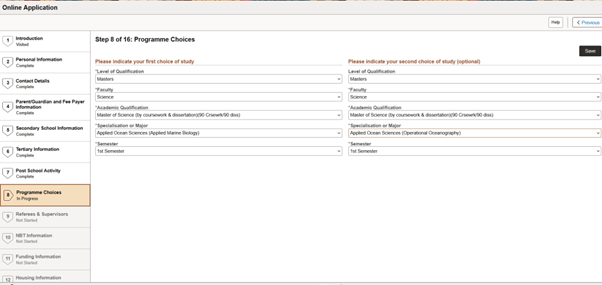
b. All students who are applying for the SAMOS NRF Bursary, must identify a possible supervisor and research project prior to their application. Please visit the SAMOS Research thematics page for a list of expertise and potential research projects available across the partner universities. When contacting a prospective supervisor, applicants must provide them with:
- A certified or official academic transcript
- A reference letter from the current supervisor, course convenor, or Head of Department addressing:
- Current academic performance
- Capacity for independent, self-directed research work
- Reliability and professionalism
- Any disciplinary record, including academic dishonesty findings or formal warnings
- The referee’s assessment of the candidate’s readiness for master’s-level study
- Ability to work in a highly collaborative environment and intensive coursework programme
c. International students must also contact the International Academic Programmes Office (IAPO) at UCT as they will be able to advise on all the necessary documentation required to study in South Africa and any other related queries.
d. Note: Incomplete applications will not be considered.
If there are any application-related queries, please contact the AOS course conveners via email: aos.maris@uct.ac.za. UCT Application-related support and documents can be found here.
South African students and permanent residents can apply for the Full Cost of Study (FCS) NRF bursary and International and national students can apply for the Partial Cost of Study (PCS). Please find more information in the Costs, funding and accommodation page. Keeping in mind that eligible students applying for the NRF bursaries must identify a possible supervisor and a research project prior to their application. Please visit the SAMOS research thematics page for a list of expertise and potential research projects available across the partner universities.
To learn more information about UCT Science Faculty admission requirements, course information, course fees and funding opportunities, check the following link: Science Faculty & Fees, Funding and Financial Assistance Handbooks.

